★★★★★
Sieora's system has given us real peace of mind. Their team understood our safety needs and delivered a solution we can genuinely rely on.
Head of Safety OperationsNippon Paint India

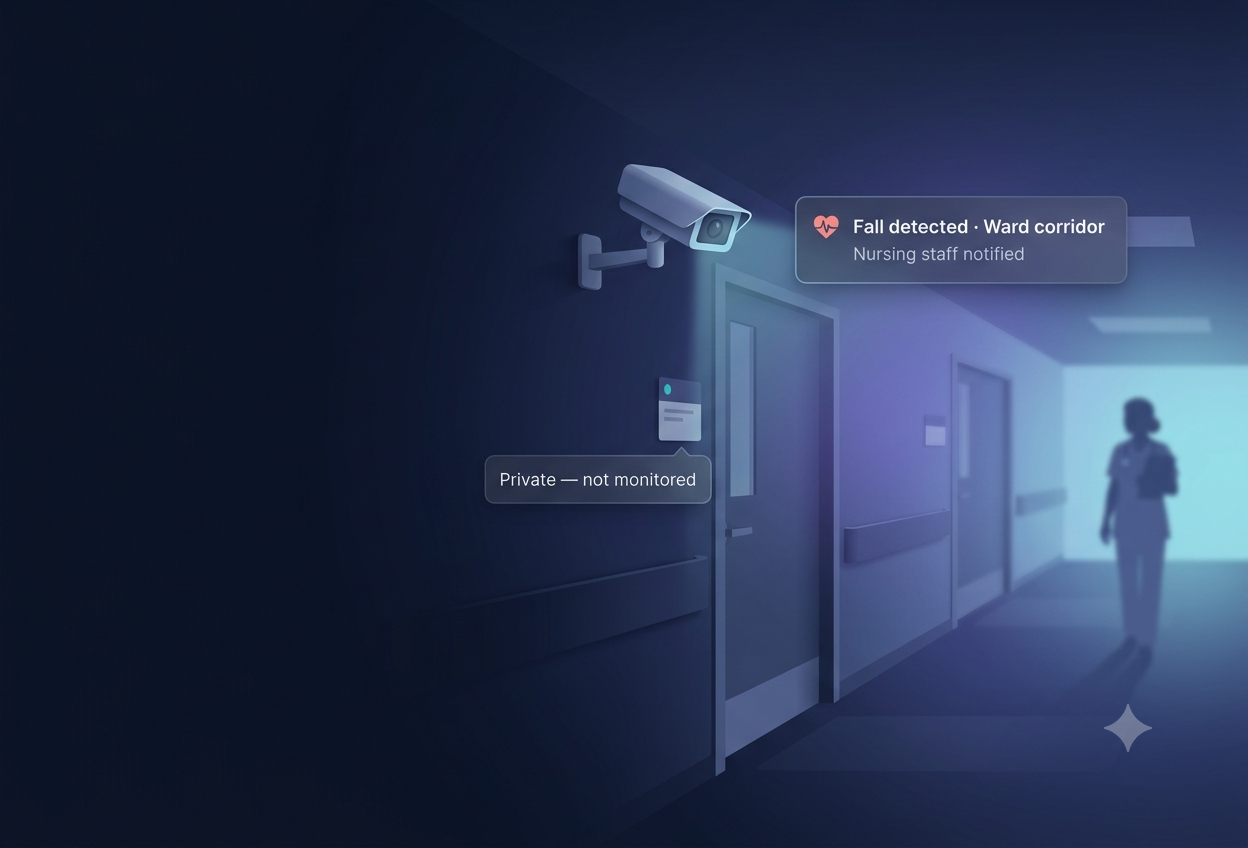
Every hospital already has cameras in its corridors, wards and entrances — and nearly all of them do just one thing: record, so the footage can be checked after something has already gone wrong. Sieora adds a layer that acts while events unfold — a fall spotted and nursing staff alerted, fire caught early, an OPD queue seen forming — on the cameras you already own. It's built privacy-first, and it supports your clinical team; it does not replace nursing rounds or clinical judgement. (Modules, zones and privacy settings are set for your hospital during an assessment.)
Enterprises, manufacturers and fast-growing startups build with Sieora.



























On a patient-facing deployment, being exact about scope matters more than almost anywhere. So before the modules, here's the honest boundary.
The honest summary: this supports your clinical team with continuous attention and a documented record. It's a layer of visibility, not a substitute for trained people — and patient dignity is a design constraint, not an afterthought.
A hospital deployment is shaped first by patient dignity. Here's exactly how that's designed in — before any module is switched on.
These aren't toggles flipped on afterward — they're the constraints the whole deployment is built around from the first conversation.
Where configured, analysis happens on-site instead of streaming everything out — so less patient data ever leaves the building.
The system can be set to analyse for a defined condition and log that event, rather than continuously recording patients throughout the day.
Cameras stay out of patient rooms, bathrooms and other private areas by design — set up as part of deployment, not left to chance.
Not everyone with a login sees everything — access to feeds and events is scoped to role, so visibility follows responsibility.
Said plainly, because it matters here more than almost anywhere: how each of these is configured is decided with your team, and privacy compliance is a property of your whole deployment — not the software alone. We'd encourage involving your own data-protection function directly. Data handling is designed with India's DPDP Act 2023 in mind. This isn't legal advice.
Only modules confirmed for your facility go live; availability is checked during the assessment. (Some are configured per deployment — marked below.)
Spots a fall event in a monitored zone and alerts nursing staff in real time, so response doesn't hinge on someone happening to be nearby or a round coinciding with the moment.
Video analytics →Catches fire and smoke risk across wards, storage and utility areas before it grows — especially where oxygen lines and flammable supplies sit near patients.
Supports a rapid alert path from a patient or staff member to the response team, tied into the same monitoring layer.
Supports visibility into hand-hygiene and protocol adherence in clinical areas — a complement to, never a replacement for, the infection-control audits you already run.
Where PPE is required in a defined zone, monitors for compliance — tuned for a clinical setting rather than an industrial one.
PPE detection →Gives a live view of queue length and wait conditions in OPD and waiting areas, so a bottleneck is visible as it builds rather than in a report afterward.
People counting →Supports visibility into how busy a ward or waiting area is right now — useful for staffing calls made in the moment, not from yesterday's pattern.
Supports attendance visibility from existing cameras rather than a separate device or badge system.
Flags access to pharmacy, records and other restricted zones outside authorised use — adding visibility once someone is already inside, which a lock alone can't.
On limits, plainly: each module's availability depends on what's genuinely confirmed for your facility — this reflects what's live, not a roadmap shown as available today. Every module needs a camera with a workable view of the zone, and no blanket accuracy figure is published; reliability is validated on your own cameras and zones during assessment. If a module you need isn't listed, ask directly.
Existing CCTV is genuinely useful — after the fact. The gap is the minutes between an event and anyone noticing, which in a hospital is exactly where the risk lives.
A fall in a corridor or ward is time-critical, and response depends on someone being nearby when it happens — which a scheduled round can't guarantee. The cost of delay shows up in the patient's outcome.
The hours with the fewest people on the floor are often the hours a patient is most likely to get up unaided. Continuous monitoring doesn't tire or thin out overnight.
A bottleneck not spotted early snowballs — by mid-morning it's a crowded waiting area and a backlog affecting every patient after it. Visibility as it forms beats a report afterward.
When a patient-safety review needs to understand what happened, the answer often rests on what someone wrote at the time — and rebuilding a timeline from paper is slow and incomplete.
None of this is a failure of care — it's the structural limit of any team: people can't be everywhere, and a passive camera only helps once you already know where to look. What analytics adds is continuous attention on the events that matter, with the alert reaching staff as it happens — while keeping patient dignity as a starting constraint.
No new hardware in patient spaces. Zones, privacy settings and alert routing are configured with your team.
Monitored zones — a ward corridor, an OPD waiting area, a pharmacy entrance — are configured with the rules relevant to each, and patient rooms and bathrooms are excluded from the start.
The AI reads feeds from cameras already covering those shared and transit areas — nothing added inside private patient spaces, with privacy settings applied per zone.
When a defined event is detected — a fall, fire, restricted access — the alert reaches the right team immediately, with the zone and an evidence image.
Each event is recorded with timestamp, zone and image in the cloud or on-premise, supporting quality and patient-safety review per your data-residency needs.
The shared and transit spaces where safety events and flow bottlenecks happen — not private patient areas.
Where falls are most likely to go unwitnessed, and where a real-time alert makes the biggest difference to response time.
Where queue and wait conditions build through the day, and live visibility lets staff act on a bottleneck as it forms.
High-traffic transit points where access, flow and general safety visibility matter — without monitoring anyone's clinical care.
Controlled zones where restricted-access flagging adds a layer of visibility a locked door alone can't provide.
Non-patient operational areas where hygiene, PPE and attendance visibility apply — away from patient-facing zones entirely.
Modules are defined on existing camera views in shared and transit areas — no dedicated hardware for the detection itself.
Edge processing, event-based detection, zone exclusions and role-based access are constraints, not bolt-ons.
Falls, fire, hygiene, OPD flow and restricted access run on the same cameras and the same platform — not a vendor per concern.
Backed by Google Cloud, NVIDIA Inception and Microsoft for Startups, with engineering and support close to you.
We say plainly this supports staff rather than replacing them, we don't publish a fall-detection accuracy figure we can't stand behind, and it isn't a medical device.
Modules, zones and privacy settings are set up around your wards and OPD before anything goes live.
Not necessarily, and that's a deliberate design choice. Processing can typically run at the edge and detection can be built around events rather than continuous recording — so the system can analyse for a defined condition and log that event rather than continuously recording patients. How it's set up is decided with your team per zone, and cameras stay out of patient rooms and bathrooms by design.
The system watches a defined zone for the posture and movement pattern of a fall and alerts nursing staff when one is detected. We don't publish an accuracy figure as our own claim — computer-vision fall detection is an active research area with promising but imperfect published results, and reliability depends on camera placement, lighting and the zone. An assessment addresses that directly rather than a blanket number. It speeds response; it doesn't replace nursing observation.
In most cases it works with existing cameras, as long as they have a workable view of the zone being monitored — angle, distance and lighting all affect reliability. An assessment identifies which cameras are suitable and where a repositioned or added camera would help.
Data handling is designed with India's DPDP Act 2023 in mind — edge processing, event-based detection, zone exclusions and role-based access all reduce how much personal data is captured and who can see it. Compliance is a property of your whole deployment and processes, not the software alone, so specifics are confirmed for your hospital and we'd encourage involving your own data-protection function. This isn't legal advice.
No — by design. Zone exclusions keep cameras out of patient rooms, bathrooms and other private areas, set up deliberately as part of deployment rather than left to chance. Patient dignity is a starting constraint, not an afterthought.
No, and it's important to be clear. It's a continuous layer of visibility that alerts staff to specific events between rounds — it doesn't make clinical decisions, assess a patient's condition, or replace the judgement of trained staff. It supports your team; it doesn't substitute for it. It is not a medical device.
It can support it. A timestamped record of detected safety events — falls, fire or smoke, restricted access — gives quality teams evidence a single round wouldn't capture, and surfaces recurring patterns by area. It's a supporting record for your own quality and accreditation processes, not a substitute, and we don't claim it satisfies any specific NABH requirement on its own.
What clients say after working with our team.
Sieora's system has given us real peace of mind. Their team understood our safety needs and delivered a solution we can genuinely rely on.
Sieora's technology has become a dependable part of our operations. The team was professional, understood our requirements, and delivered quality.
A capable, professional team that delivered exactly what our quality processes needed. Sieora made the whole engagement smooth and reliable.
Sieora delivered a robust, well-engineered solution and supported us throughout. A reliable technology partner we trust.
The team understood our security and monitoring needs precisely and delivered a system that works reliably day in, day out.
The right starting point isn't a demo of every module — it's a conversation about which genuinely fit your wards, your OPD and your privacy requirements, and which don't apply at all.
Which safety, compliance and operations modules genuinely apply — and which zones would gain nothing.
Which existing cameras have a workable view of the shared areas that matter, with patient rooms and bathrooms excluded from the start.
How edge processing, event-based detection and zone exclusions would be set up for your specific areas.
What this supports and what it doesn't — including that it complements, rather than replaces, your clinical team.
Send us a message and our team will get back within one business day.
An assessment looks at your actual wards, OPD and existing camera coverage, sets out a privacy configuration for your areas, and is honest about which modules fit and which don't — including that this supports your clinical team rather than replacing it.
Not a medical device. This software is not a medical device and is not intended to diagnose, treat, cure, monitor or prevent any disease or medical condition. It does not assess a patient's clinical condition, make clinical decisions, or provide clinical advice. It provides event detection and alerting to support a hospital's own staff and processes.
Supports, does not replace clinical staff. The system provides a continuous layer of visibility and alerting between rounds. It does not replace nursing rounds, direct patient observation, or the judgement of trained clinical staff, all of which remain the hospital's responsibility. Alerts are informational outputs; all clinical and operational decisions remain entirely with the hospital's personnel.
Fall detection — no accuracy figure claimed. Sieora does not publish a fall-detection accuracy or detection-rate figure as its own claim. Computer-vision fall detection is an active research area with promising but imperfect published results, and reliability depends materially on camera placement, angle, lighting, occlusion and the specific zone. Performance for a given deployment is validated on the hospital's own cameras and zones during assessment. The system supports faster response to detected events; it does not guarantee detection of every event.
Patient privacy and dignity. The system is designed so that cameras are excluded from patient rooms, bathrooms and other private areas. Edge processing, event-based detection and role-based access are configurable to minimise data captured and access granted, but the specific configuration, and responsibility for its adequacy, rests with the hospital. Privacy and data-protection compliance is a property of the hospital's overall deployment and processes, not of the software alone.
Data protection. Monitoring in shared and transit areas captures images of patients, staff and visitors incidentally. Hospitals should align deployments with applicable data-protection obligations, including the DPDP Act 2023 in India, and with signage, notice and consent requirements. Role-based access, retention and data residency are configured per deployment. This is not legal advice — confirm your approach with your own legal, data-protection and clinical-governance functions.
Accreditation. References to NABH or patient-safety documentation describe how a timestamped event record can support a hospital's own quality and accreditation processes. Sieora does not claim that the software satisfies any specific NABH standard or accreditation requirement, and any such determination rests with the hospital and the relevant accrediting body.
Module availability. Modules described — including SOS signalling and staff attendance, marked as configured per deployment — are available subject to confirmation for a specific facility at assessment. This page reflects current operational capability, not a roadmap presented as available today.
Customer references. No hospital or healthcare provider is named or implied as a Sieora customer on this page. Environments and scenarios described are illustrative of typical hospital settings. A live enquiry or assessment does not constitute a deployment. Customer-specific references are provided only under written consent at the sales engagement stage.
Cloud & deployment. Cloud, edge and on-premise deployment options are available — on-premise is frequently relevant for patient-data residency. Region and residency configuration are confirmed per deployment.
Forward-looking statements. References to product capabilities reflect the platform's current operational state as of the page modification date. Roadmap items may shift in scope or timing.