
★★★★★
Sieora's system has given us real peace of mind. Their team understood our safety needs and delivered a solution we can genuinely rely on.
Head of Safety OperationsNippon Paint India
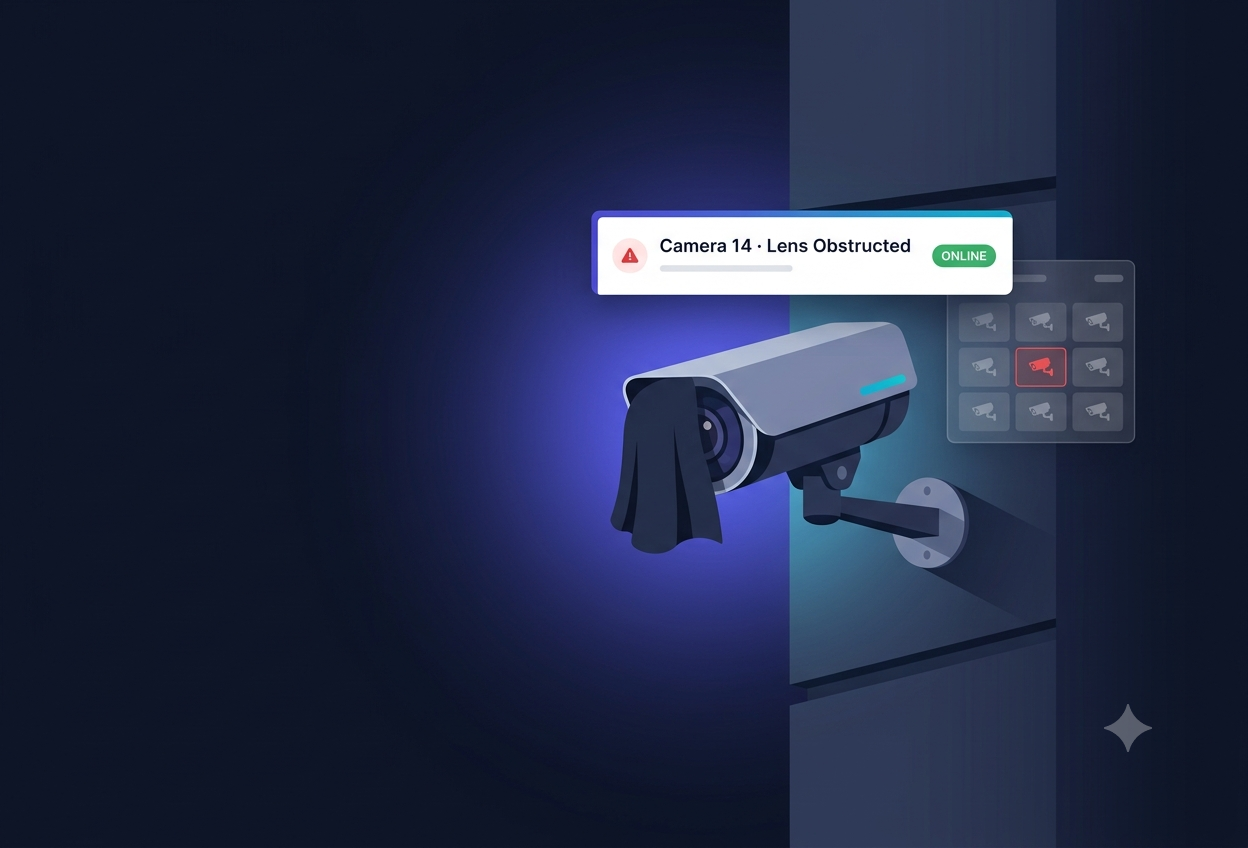
Sabotage a camera and every dashboard still shows it green — picture streaming, recorder writing, status fine. The catch is the lens is bagged, or the housing has been swung at the ceiling. You only find out when you reach for footage that isn't there. Sieora watches for that interference the moment it happens, on whatever brands you already run, from a single console — so you hear about it now, not during an investigation. (Tamper types, sensitivity and alert routing are set for your own cameras during a free assessment.)
Enterprises, manufacturers and fast-growing startups build with Sieora.



























The single thing most teams miss: whether a camera broke and whether someone knocked it out are not the same question — and a status dashboard only answers the first one.
A technical fault — dropped offline, storage full, recording stopped. It raises an error, and monitoring picks it up.
A security event. A covered lens is in flawless technical health — feed live, recorder running — and utterly useless. It raises nothing on its own. Closing that silent gap is the whole job.
Both matter, and a serious site wants both. But sabotage hides precisely because it doesn't look like a fault — which is why it needs its own detection rather than a health check.
Each is read from the camera's own existing stream — nothing extra bolted on at the camera.
A bag, a spray, a palm, an object shoved against the glass — caught by the abrupt, lasting collapse of scene detail when a working camera suddenly sees nothing.
A field of view that's drifted well off what it should cover — twisted toward a wall, tilted off an entrance, pointed somewhere it was never meant to look.
A lasting drop in sharpness — twisted out of focus on purpose or by accident, it keeps recording, but only a smear no one can use.
A feed that's dropped or been cut outright — a deliberately severed connection told apart from an everyday network hiccup.
On the limits, no spin: what's caught reliably depends on the camera's own picture quality and how obvious the change is — a faint partial cover is harder than a fully bagged lens, and a slow re-aim harder than a sharp one. We don't quote a single accuracy number; we prove reliability on your own cameras during the assessment.
People rarely knock out a camera on a whim — it's often the setup for a theft, a break-in, or quiet damage. Spot it live and you can act before the rest unfolds.
On a site with hundreds of cameras, one facing a wall can slip by for days — most of all at unstaffed sites where footage is only pulled after something's gone wrong.
Many cameras have their own tamper alarm, but it swings by brand and generation — dependable on some, flimsy on others — leaving a mixed fleet with patchy protection and no shared view.
Firmware tamper alarms differ maker by maker. Sieora connects to any IP or CCTV camera over open standards, so the tamper cover you get is identical on every camera regardless of who built it — no rip-and-replace, no single-vendor lock-in.
No new hardware at the camera. Sensitivity and alert routing are tuned per site.
Each camera's everyday picture becomes its reference — what it ought to be seeing under ordinary conditions.
The model measures the live feed against that reference and, crucially, weighs how the picture changed — so a drifting shadow or headlight sweep isn't mistaken for a covered lens.
An alert usually waits a minimum duration, so a quick lens wipe or someone crossing the shot for a second doesn't fire the way sustained interference does.
Confirmed events reach your team in real time with a timestamped still, and are logged in one console across every site and brand.
Anywhere a camera going quietly blind would cost you — and no one would clock it for a while.
Back-of-house and staff-only areas, where a knocked-out camera can front-run internal shrinkage.
Places in banking and finance where a compromised camera is a live security matter to act on, not an IT ticket.
Sprawling camera counts where one dead camera among hundreds can hide for a long time.
Locations with no one on hand, where footage is only pulled after the event and unbroken coverage is simply assumed.
Operations spanning several locations — and usually several camera brands — where one shared view matters most.
Cash rooms, server rooms and secure stores, where a camera being knocked out is itself the thing to react to.
Detection behaves identically whoever made the camera — a mixed fleet gets even cover instead of results that lurch from unit to unit.
A single view of tamper events across the whole estate, not a separate check at each location.
Sits alongside Sieora's video analytics, Cloud VMS and ANPR — same feeds, same platform.
Where a camera's built-in tamper alarm works well, it's worth keeping. Our value is even cover across brands and one shared view — not a claim that your current cameras have no protection.
Chennai-based engineering and support, with detection proven on your own cameras before it goes live.
An offline camera raises a fault, and uptime tools catch it. A tampered camera raises nothing — as far as the system can tell it's working, with the feed live and the recorder writing. It's simply been made useless. Tamper detection is the security answer to that, not the uptime one.
Four today: a covered or blocked view, a camera moved or turned away from its area, a picture knocked out of focus, and a feed that's dropped or been cut. Each is a separate way a camera stops being useful while often still looking "online" at a glance.
Many cameras carry a firmware tamper alarm, and where it works well it's worth keeping. The gap is uneven cover across a mixed fleet — firmware behaviour differs maker to maker. Sieora behaves the same on every brand, from one console, so protection no longer depends on which camera sits where.
It weighs how the picture changed, not merely that it changed, and usually waits a minimum duration before alerting. A drifting shadow, a shift in light, or a quick pass in front of the lens reads very differently from sustained interference.
Yes. It connects over ONVIF, RTSP and standard NVR APIs, so it works across whatever brands are already in your estate rather than needing one specific maker.
What clients say after working with our team.
Sieora's system has given us real peace of mind. Their team understood our safety needs and delivered a solution we can genuinely rely on.
Sieora's technology has become a dependable part of our operations. The team was professional, understood our requirements, and delivered quality.
A capable, professional team that delivered exactly what our quality processes needed. Sieora made the whole engagement smooth and reliable.
Sieora delivered a robust, well-engineered solution and supported us throughout. A reliable technology partner we trust.
The team understood our security and monitoring needs precisely and delivered a system that works reliably day in, day out.
If the first you'd hear of a knocked-out camera is when you reach for footage that isn't there, the window to act has already closed. A demo shows exactly what gets caught on your own cameras, whatever brands you run.
Which of your cameras already have a usable firmware alarm, and where the real gaps sit.
Tested against your cameras and lighting — not a number lifted from someone else's estate.
Where tamper alerts go and who acts on them, set around how your team already works.
Send us a message and our team will get back within one business day.
Don't let a covered camera surface only when you go looking for footage that isn't there. See exactly what Sieora catches on your own cameras, across whatever brands you run.
Scope — security, not upkeep. This detects deliberate interference with a camera. It does not address technical failure, uptime, storage health or maintenance. Where the page contrasts the two, it does so to mark the boundary, not to claim uptime-monitoring capability.
Existing camera tamper features are real. Many CCTV cameras include a firmware tamper alarm. Sieora does not claim such features fail to exist or fail to work. Where a camera's built-in detection performs well, it's legitimate and useful. The differentiation here is consistency across a mixed-brand estate and one central view — not a claim of superior accuracy over any specific manufacturer, and no such comparative claim is made or implied.
Detected tamper types. Four categories: covered or blocked lens, moved or redirected camera, defocused image, and signal loss / feed interruption. Obstruction by spray falls within covered-or-blocked. No other category is claimed. Detection of any specific scenario is confirmed against the customer's own cameras during assessment.
No accuracy percentage. No detection-accuracy figure is published. Reliability depends on the camera's own image quality, lighting, scene dynamics and the nature of the interference. Limits are stated plainly and reliability is validated on your own cameras.
Detection is not prevention. This detects and alerts; it does not physically prevent tampering or intervene. Alerts are informational outputs with evidence images, and how they're acted upon is the customer's responsibility.
Data protection. Detection operates on existing camera feeds and may capture incidental images of people. Align deployments with applicable obligations, including the DPDP Act 2023 in India, and any site signage requirements. This is not legal advice — confirm with your own legal and compliance teams.
Camera brand trademarks. Camera brand names referenced anywhere on Sieora's site are trademarks of their respective owners. Compatibility is via ONVIF, RTSP or vendor NVR APIs and does not imply endorsement or partnership.